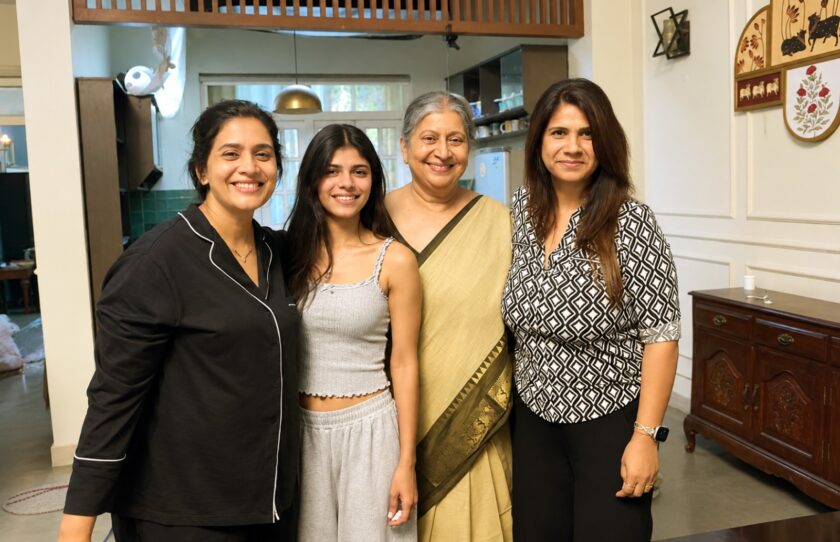
Mumbai: Actor Vidhatri Bandi is steadily carving her own space in Indian cinema with performances that reflect both versatility and emotional depth. From Shiddat and Jalsa to The Diplomat and her latest film Max, Min & Meowzaki, Bandi has embraced characters that have challenged her as a performer while allowing her to grow with every project. Her latest film, directed by Padmakumar Narasimhamurthy, connected with her on a deeply personal level, particularly through its exploration of relationships, grief, acceptance and the ways people often take loved ones for granted.
In an exclusive conversation, Bandi speaks about what drew her to Max, Min & Meowzaki, the challenge of working with a cat despite her allergy to fur, and the support she received from her director and co-star Siddharth Menon. She also looks back at Jalsa, which she describes as a major turning point, and recalls the confidence she gained from sharing the screen with Vidya Balan and Shefali Shah. Reflecting on her training at UCLA, her experience working with John Abraham in The Diplomat, and her stint as an assistant director, Bandi discusses how every phase of her journey has shaped her approach to acting.

With a dream of playing a classical dancer and a desire to explore commercial cinema, independent films and OTT, Bandi says she is now focused on substantial roles that genuinely excite her.
1) You recently appeared in Max, Min & Meowzaki – what drew you to this project, and how does it differ from your previous roles?
What drew me to Max, Min & Meowzaki was the beautiful writing and the way my director, Padmakumar Narasimhamurthy, narrated the film. I think it was the first time in my life that I was sitting with a group of strangers and literally crying my eyes out during a narration because that’s how deeply the story moved me.
What really stayed with me was the context of the film and how timeless its themes are. It’s about relationships, flawed relationships, the ways we neglect or overlook the people we love, how easily we can take them for granted, and ultimately, the importance of accepting people for who they are.
And I don’t use the word “timeless” just because I’m part of the film. I genuinely believe that the things this film talks about will always resonate with people, regardless of their age. I’ve had a 15-year-old boy come up to me and tell me how much he loved the film, and I’ve also had a 60-year-old man tell me the same thing. That ability to connect so effortlessly across generations is what makes the film really special to me.
I remember when I first heard the narration, it spoke to me very deeply. My immediate thought was that I wanted to watch this film with my parents. Not because there’s anything wrong with our relationship, but because there are certain things we all take for granted when it comes to the people we love. I think this film gently makes you reflect on those things.
So for me, Max, Min & Meowzaki is very different from my previous work because it made me connect with the story on a deeply personal level. It’s a film that speaks to our generation, the next generation and the generation before us, and I truly believe that’s why its message will always remain relevant
2) Can you share a memorable moment or challenge from the sets of your latest film? What was the atmosphere like working with the cast and crew?
One of the biggest challenges initially was that I’m allergic to fur, so bonding with the cat was definitely a bit of a struggle! But I think once I gave it some space and time, and allowed myself to settle into the character, it became much easier.
The other challenge was understanding Carol, especially the grief I was carrying. It took me some time to really understand her emotional world and find my way into the character. I think being patient with myself was important, but so was having the right people around me. My director Padmakumar Narasimhamurthy and Siddharth Menon, my co-actor, really helped me find that rhythm and ease into the character. I don’t think I could have found Carol in the same way without their support. I was truly lucky to be a part of this film and collaborate with such wonderful artists.
3) In The Diplomat alongside John Abraham, you mentioned feeling like a student on set. What key lessons did you learn from working with such an experienced actor and team?
I was really inspired by John’s dedication and the discipline with which he showed up on set. I had always heard about his commitment as an actor, but seeing it firsthand was a completely different experience. What really stayed with me was how, even after being in the industry for so many years, he continues to bring the same enthusiasm, focus and energy to his work.
Interestingly, my own journey with fitness and taking better care of my body actually began after working on this film. Watching John’s discipline and the way he prioritises his craft and his body really inspired me to do the same. I think that has been my biggest takeaway from working with him – that no matter how long you’ve been in this industry, you should never lose that curiosity, discipline and enthusiasm for what you do.
4) Looking back at your journey from graduating UCLA TFT in 2016 to starring in notable films like Jalsa and Shiddat, what has been the most significant turning point in your career?
I would say the most significant turning point in my career has been Jalsa. I have always admired and looked up to Vidya Balan and Shefali Shah, they’re both tremendously talented artists, so being part of a film with them and being able to hold my own and give a performance that people remembered was a huge achievement for me.
When I was first locked for the film, I was honestly terrified. I remember wondering if I would even be able to say a line in front of Vidya ma’am! But a huge part of why I was able to overcome that fear was because of Vidya ma’am and my director, Suresh Triveni. They made me feel incredibly comfortable and welcomed. Their warmth, generosity and professionalism made the entire experience so much easier for me.
Jalsa will always be special because the character was so different from anything I had done before. I also got to experiment with the accent and alter my voice, which was a really exciting challenge as an actor. More than anything, though, the film really amplified my confidence, it made me realise that I could share the screen with such brilliant artists and work with a director of such calibre, and still find my own space as a performer.
5) What kind of characters or genres are you most excited to explore next in your career? Any dream roles you’d love to take on?
I would honestly love to play all kinds of characters. I don’t really like to limit myself when it comes to the kind of roles I want to explore. But if I had to pick one dream role, I would absolutely love to play a classical dancer. That has always been a dream of mine, perhaps a Kathak dancer, or a character who allows me to explore any form of dance.
I’ve always loved and enjoyed dance, so getting the opportunity to learn a new art form and incorporate that into a character would be incredibly exciting for me. Beyond that, I don’t really have a list of roles or a very fixed plan. I just want to remain open to whatever comes my way, as long as the character or the story genuinely excites me and makes me want to get to work.
6) You’ve worked in both Bollywood and international projects. How has your training in the US influenced your approach to acting in Indian cinema?
My training in the US was honestly such a beautiful and transformative experience. It helped me tap into a much deeper part of myself as a performer, parts of me that I didn’t even know existed.
I was the youngest person in my class and the only Indian, and I was surrounded by people who were five, seven, even eight years older than me. So initially, it was quite intimidating. But in many ways, that environment ended up building my confidence. I’ve always had a tendency to underestimate myself, and self-doubt is something I still struggle with even today. But if there’s one thing my training in the US taught me, it was to trust myself more and have confidence in myself as a performer.
It also gave me the opportunity to meet and learn from some incredibly talented actors, writers and directors, and to work in environments that pushed me creatively. I even had the opportunity to perform in front of Jennifer Aniston, which was an experience I’ll always cherish.
Looking back, that entire journey was one of the most exciting and educational phases of my life. It didn’t just teach me about acting; it taught me a lot about myself, and I think that continues to influence the way I approach my work today.
7) Your role in Jalsa received a lot of appreciation. How did that global release impact your career, and what feedback from audiences stood out to you?
Jalsa was one of the most exciting films of my career because it gave me the opportunity to share the screen with some of the most brilliant artists, especially Vidya Balan and Shefali Shah, whom I’ve always looked up to.

One of the most rewarding things for me was how convinced people were that I was actually Malayali. I would receive messages and DMs asking me where in Kerala I was from, and that honestly felt like such a compliment because I knew I had done my job. I had worked quite a bit on the accent and my voice for the character, so seeing people completely believe it was incredibly satisfying.
Another moment that has stayed with me was when Shefali ma’am actually got my number from Suresh sir and messaged me to compliment my work. Vidya ma’am also sent me a lovely message. I still have screenshots of both of those messages, and I genuinely go back and read them whenever I’m feeling underconfident. They’re little reminders that mean a lot to me.
So beyond the wider appreciation the film received, Jalsa gave me something very personal, the confidence that I could hold my own alongside artists I deeply admire, and that my work could resonate with audiences.
8) As someone who has also worked as an assistant director, how does that experience behind the camera shape the way you prepare for and perform in front of it?
Honestly, working as an assistant director has helped me in so many ways. It has given me a lot of clarity and confidence when I’m on a set. Because I’ve experienced the process from behind the camera, I understand the intricacies of what goes into making a film, why delays happen, why things sometimes go right or wrong, and how many moving parts there are on a set.
For instance, if an assistant director comes to me today and says, “We’ve called you in, but you might have to wait for five hours,” I understand why that can happen. If I hadn’t had that experience, I might have taken it personally as an actor. But having worked behind the camera has given me a much broader perspective and a better understanding of the entire process.
I think that experience has also made me feel very comfortable on a set. I often say that it allows me to look at a set almost like my home. When I walk onto one now, I have a sense of what’s happening and why it’s happening, and that knowledge takes away a lot of the discomfort or uncertainty. So, I definitely think having that experience behind the camera has added a great deal of value to my journey as an actor.
9) The film industry has evolved rapidly with streaming platforms. How has this changed opportunities for actors like you, and what are your thoughts on the current landscape?
I think streaming platforms have definitely opened up a lot of space and created a wonderful stage for actors to showcase their skills. They’ve given so many people the opportunity to be seen, recognised and appreciated, and I think that has been a really positive change for the industry.
Having said that, I’ve always been someone who has wanted to act in films. I grew up dreaming about feature films and theatrical cinema, so that’s naturally where my heart leans a little more. My journey so far has also largely been through films, Shiddat, Jalsa, The Diplomat and Max, Min & Meowzaki, so I think I’ve always been more of a film person.
But at the same time, I also understand that the industry is changing and OTT is a huge part of the landscape today. So I don’t have any hesitation about doing a series. I would absolutely love to explore that space; I just haven’t had the opportunity yet. For me, it ultimately comes down to the story and the character. It has to genuinely excite me.
And there are so many shows that make you want to be part of that kind of storytelling. I’ve really enjoyed shows like Delhi Crime, Safed Sagar, Khauf and Farzi, for instance. When you see the kind of storytelling and performances that are happening on OTT, you definitely want to experience that world too. So while my heart will probably always lean a little more towards films and theatrical cinema, I’m completely open to exploring series if the right opportunity comes along.
10) Could you tell us about the preparation process for your recent roles? Any specific techniques, research, or physical transformations involved?
Honestly, I don’t have a very specific or intense preparation process. I think the first thing I do when I step onto a new set or start working with a new team is understand how they work. I’ve been fortunate enough to work with very different kinds of directors, and each of them has had a completely different process. I find that fascinating, and I really enjoy adapting to those different ways of working.
For me, a lot of it comes down to the rapport I build with the director. Once I understand their vision and how they like to work, I know how much I can experiment and play around. Some directors are very open to improvisation and give you the freedom to explore, while others have a very specific vision and want things to be done exactly as they’ve imagined them. In those situations, I respect that and try to serve their vision rather than impose my own ideas.
So I think my preparation is really about understanding the character inside out, but equally understanding the director’s vision. I first gauge the set, the people I’m working with and what the director wants, and then I find my way into the character accordingly. Once that understanding is there, everything else tends to flow quite naturally and effortlessly.
11) What advice would you give to aspiring actors, especially those pursuing formal training abroad and then returning to the Indian film industry?
I usually refrain from giving advice to actors, and I don’t mean that in an arrogant or dismissive way. I just genuinely feel that this is such a fascinating industry because everyone’s journey is so different. When I look at myself and my contemporaries, we’ve all taken completely different paths. There’s no formula where I can say, “Do this and you will get that,” because I don’t think it works that way.
But if there’s one thing I would really emphasise, it’s to take your auditions seriously. It sounds like such a basic thing, but I know a lot of people who don’t necessarily treat an audition with the importance it deserves because they think, “It’s just an audition.” I actually think auditions can do wonders for your career.
My entire career trajectory has been shaped by auditions. For example, with Max, Min & Meowzaki, I had originally auditioned for Min, but I ended up getting Carol. There have been many instances where an audition has led me to something completely different. Sometimes you may not be right for the particular role you’re auditioning for, but a casting director remembers you and thinks of you for something else later.
I always say that auditioning is your job as an actor. Once you get the part, that’s your promotion! So take the job seriously.
Apart from that, I don’t think there’s a magic pill or a single piece of advice that can guarantee you a destination. There are so many different ways of getting to your dream and achieving your goals, and there really isn’t one right way. You just have to find the path that works for you.
12) With multiple projects under your belt now, how do you balance staying true to your artistic instincts while navigating the commercial aspects of the industry? What are your goals for the next few years?
Honestly, I want to do all kinds of films. I want to be part of commercial cinema, independent films, OTT projects, I don’t ever want to limit myself in anyway. I want to explore different platforms, different genres and all kinds of characters, and most importantly, enjoy the process.
At the same time, I’m also very aware of the kind of person I am. If I say yes to something, it has to genuinely excite me. I don’t want to do something simply for the sake of doing it. So while I definitely have this vision of exploring different kinds of cinema and pushing myself as an actor, I also want to make sure that the work I choose continues to inspire me.
I’m very happy with where I am right now, and that doesn’t mean I’m being complacent or laid-back. I’ve always believed that the destination is just a destination; it’s the journey that makes the whole thing interesting. I want my journey to keep challenging me, teaching me and inspiring me to become better. Now that I’ve played a lead in a film, I’m only focusing on substantial parts.
When I look at my career trajectory – from playing a supporting character in Shiddat, to a more central role in Jalsa, and now a lead in Max, Min & Meowzaki, I feel like I’m slowly climbing up the ladder.
Whatever happens, I’m just grateful that I’m doing what I love and, in many ways, what my six-year-old self dreamt of doing. And I think that, ultimately, is my biggest privilege. I just have to work hard and see where my work takes me.